

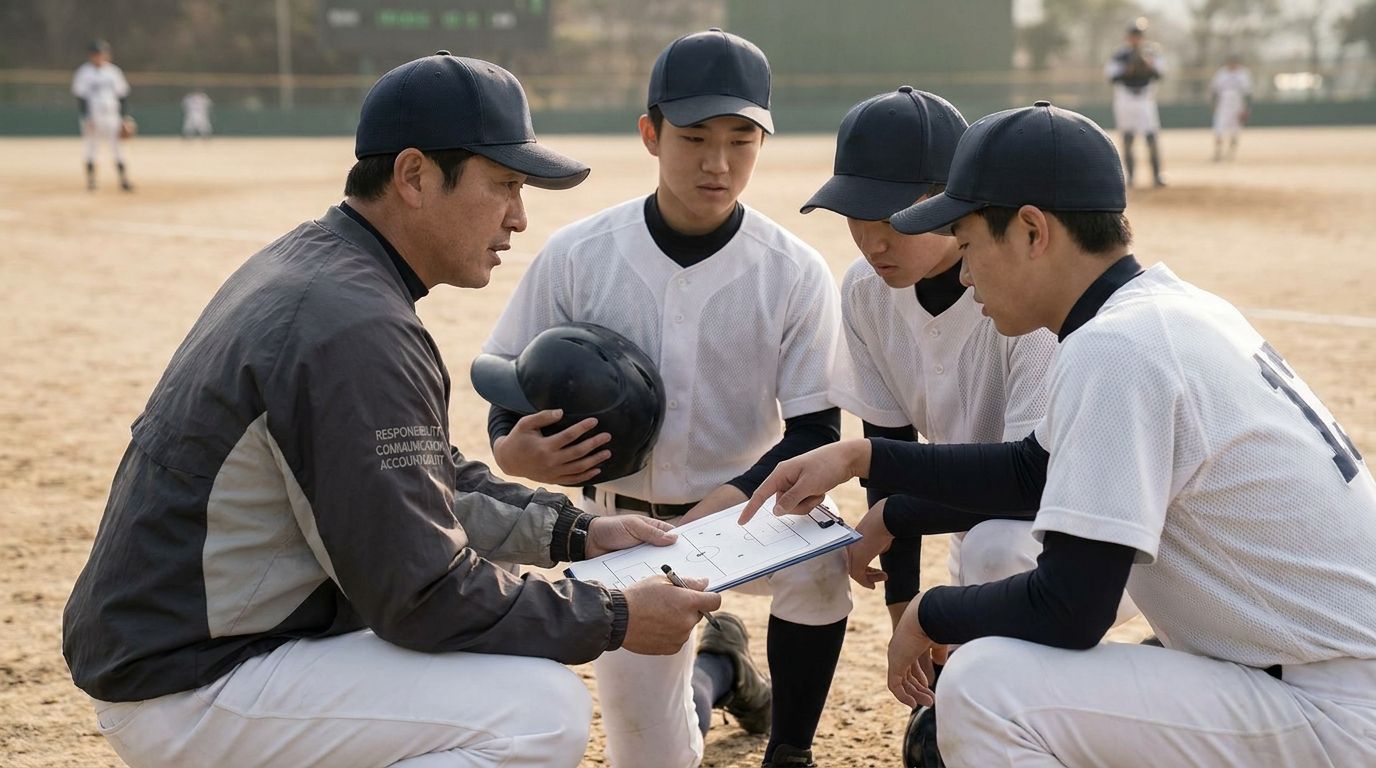
Baseball coaching lessons make student teams more accountable when you turn expectations into daily habits: clear roles, visible effort standards, player-owned goals, and fair consequences. Accountability grows fastest when students know what “ready,” “responsible,” and “team-first” look like before practice starts.
If you coach baseball, advise a student club, lead a classroom team, or manage any youth group, you’ve seen the same pattern: talent doesn’t fix missed details. Players forget gear, arrive late, drift during drills, or wait for an adult to correct every mistake. The goal is to build a team that can regulate itself without turning you into a constant enforcer.
Why “Because I Said So” Doesn’t Build Real Accountability
Command-based coaching can create short-term compliance, but it rarely builds ownership. A student may hustle when you’re watching, stay quiet when you raise your voice, or follow a rule to avoid punishment. That’s not the same as choosing the team standard when no adult is hovering nearby.
Real accountability starts when players understand the standard, accept their part in it, and help protect it. In baseball, that can mean arriving early enough to warm up safely, knowing bunt coverage before a game situation appears, and taking care of the field without being reminded. In a student team outside baseball, it can mean preparing materials, meeting deadlines, or giving honest feedback without blaming the group.
You don’t need to lower standards to stop yelling. You need to make standards plain, repeatable, and shared. When players help define what responsible behavior looks like, they’re more likely to defend it. That shift changes your role from full-time traffic cop to steady teacher, planner, and culture-setter.
The Baseball Blueprint: How Practice Design Teaches Responsibility Without A Lecture
Baseball is built for accountability because every practice has moving parts. Players rotate through stations, handle equipment, track reps, communicate on defense, and respond to live situations. If you design those parts well, the routine itself teaches responsibility.
Start with a pre-practice checklist. Players should know where bags go, who sets up nets, who grabs baseballs, who leads warmups, and what time the first drill begins. The checklist should be short enough to use every day and specific enough that “I didn’t know” stops being a common excuse.
Station work makes responsibility visible. One group can handle tee work, another can run fielding footwork, another can track throws, and another can review signs or situations. You’re still supervising, but players learn to manage time, equipment, effort, and transitions. That’s one of the cleanest baseball coaching lessons for student teams: structure beats speeches.
From Captain To Co-Owner: Giving Players Authority And Real Responsibility
Captains shouldn’t be decorative titles. If you name student leaders, give them a real job, clear limits, and a way to report what they see. A captain can lead warmups, check attendance, help younger players understand routines, or run a short team reset after practice.
Player leadership works best when it’s shared. A single captain can become overloaded or seen as the coach’s messenger. A small leadership group can divide responsibilities: one player tracks preparation, one watches energy during drills, one checks communication, and one helps new players learn team routines.
Authority also needs boundaries. Players can remind teammates of standards, but they shouldn’t shame, threaten, or create their own punishments. Your job is to train leaders to ask direct questions: “Are you ready for the next rep?” “Do you know your cutoff?” “Did you finish your role sheet?” That keeps peer accountability useful instead of personal.
The Scoreboard Never Lies: Making Effort A Measurable Stat
If you want accountability to become real, measure more than hits, errors, and wins. Student teams often drift because only outcomes get attention. Effort behaviors need a scoreboard too.
Track controllable actions. In baseball, those can include on-time arrival, sprinting through first base, backing up throws, calling for the ball, completing assigned reps, and bringing required gear. In a non-sport student team, those can include meeting prep deadlines, contributing during planning, completing assigned tasks, and helping clean shared work areas.
Keep the system simple. A team can track three effort standards per week instead of creating a long chart no one maintains. Use language students understand: ready on time, locked in during reps, helpful after mistakes. When effort is visible, accountability stops feeling like a vague lecture and starts becoming a shared team habit.
Goal-Setting Turns Accountability Into A Personal Commitment
Accountability gets stronger when every player owns a specific goal tied to a role. “Get better” is too broad. “Take 50 quality swings three days per week,” “lead outfield communication during practice,” or “arrive ten minutes early for catcher gear checks” gives a student a clear target.
Public commitment can help when it’s handled with care. Ask players to state one measurable goal to a small group, captain, or coach. The goal should connect to preparation, effort, communication, or team role, not just personal statistics.
Review goals on a regular schedule. A short check-in after practice works better than a long meeting that happens once and disappears. Ask three questions: What did you commit to? What did you complete? What support do you need before the next practice? That keeps ownership active without turning every mistake into a lecture.
When Players Drop The Ball: Constructive Consequences Without Humiliation
Accountability doesn’t mean every mistake deserves punishment. Baseball has errors, missed signs, bad throws, and mental slips. Student teams have missed deadlines, weak preparation, and moments of low focus. The response should teach the standard, not embarrass the student.
Use consequences that connect to the behavior. If a player leaves equipment out, that player helps inspect and store equipment after practice. If a group fails to communicate during a drill, they repeat the communication part before moving forward. If a student leader misses a responsibility, the follow-up should include a private review and a clear repair action.
Save benching or removal for repeated, serious, or safety-related problems. Many accountability issues can be corrected with private conversation, role clarity, and a repair task. The strongest message is calm consistency: the standard applies to starters, reserves, captains, and younger players alike.
Translating The Diamond Wisdom To Any Student Team
You don’t need a baseball field to use these lessons. The same ideas work for student government, robotics teams, debate teams, academic clubs, music groups, and service organizations. Any student team can define preparation, assign roles, track effort, and review follow-through.
Replace baseball drills with work cycles. A club can open every meeting with a five-minute readiness check, assign one student to materials, one to timekeeping, one to notes, and one to follow-up tasks. A robotics team can track tool cleanup, build notes, safety checks, and task completion. A debate team can track research prep, practice attendance, evidence organization, and peer feedback.
The transfer is simple: make responsibility observable. Students can’t improve what remains hidden. When the team can see who prepared, who helped, who communicated, and who repaired mistakes, accountability becomes part of how the group works.
The Coach’s Self-Audit: Are You Modeling The Accountability You Demand?
Student teams watch what adults tolerate. If you ask players to be prepared but change plans without explanation, accountability loses force. If you demand punctuality but start practice late, students learn that standards are flexible.
Audit your own habits before blaming the roster. Do you post practice plans early enough for players to understand the day? Do you explain roles before evaluating performance? Do you follow the same consequence process for every player? Do you correct behavior privately when privacy is the better teaching tool?
Your consistency sets the ceiling for team accountability. Players don’t need perfection from you. They do need fairness, follow-through, and clear communication. When you model those habits, your standards carry more weight.
How To Build A Team Minimum Standard Agreement
A minimum standard agreement gives your team a shared baseline. It should answer one practical question: What must every member do for the group to function well? Keep it short, visible, and written in student-friendly language.
Build it with the team rather than handing it down as a rule sheet. Ask players to name the behaviors that help practice run well and the behaviors that waste team time. Then sort their answers into a few categories: preparation, effort, communication, respect for roles, and response to mistakes.
The finished agreement can include statements like “We arrive ready before start time,” “We sprint between drill stations,” “We own missed assignments without excuses,” and “We help reset after mistakes.” Review it before the season, after rough stretches, and anytime team habits begin to slip. Accountability improves when the standard is easy to remember and hard to ignore.
How Do Baseball Coaches Teach Accountability?
- Set clear team standards
- Use role-based practice drills
- Track controllable effort
- Let players self-review
- Apply fair repair actions
Make Accountability A Daily Team Habit
Baseball coaching lessons work for student teams because they turn responsibility into visible behavior. You define the standard, build routines that require ownership, measure controllable effort, and respond to mistakes with fair repair actions. The best teams don’t rely on one loud adult to hold everything together. They learn how to prepare, communicate, correct, and lead from inside the group. If you want more accountability, start with one standard your students can see, practice, and protect every day.
References
- Positive Coaching Alliance(PCA): Double-Goal Coach
- USA Baseball: Long Term Athlete Development(LTAD)
- National Federation of State High School Associations(NFHS): Ownership And Accountability In High School Baseball
- Association For Applied Sport Psychology(AASP): Building Team Cohesion
- National Collegiate Athletic Association(NCAA): Student-Athlete Well-Being Study
- Coaching Toolbox: Teaching Accountability In Baseball

